
August 15, 1945 – Let Us Sing the Song of This Nation’s Liberation(Exodus 15:1–18, Galatians 6:2–8)
August 15, 1945 – Let Us Sing the Song of
This Nation’s Liberation
(Exodus 15:1–18, Galatians 6:2–8)
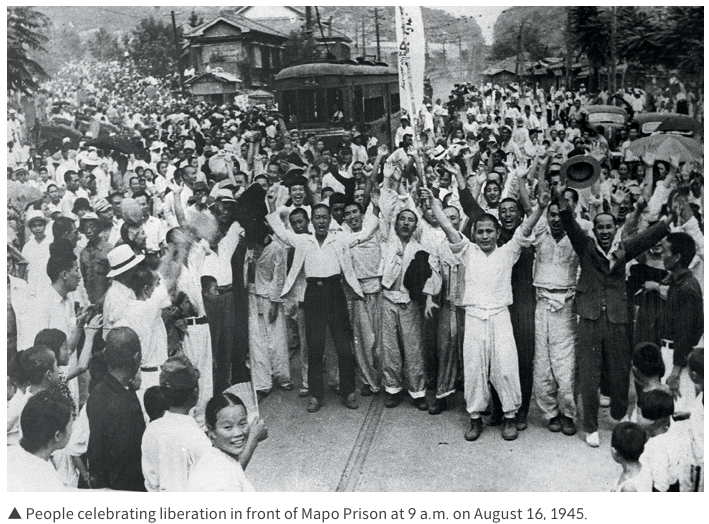
For thousands of years, since the Korean people have settled on the Korean Peninsula and lived together as a national community, we have lived as a good and upright people who loved peace. Yet there came a time when we lost our country to Imperial Japan and lived sorrowfully as a people of a ruined nation. This was not how we intended to live when we hoped for liberation from Japanese rule. On the day of our nation’s independence, didn’t
we as a people resolve to cherish and love one another as we remembered the sorrow or our fallen nation? How long we waited for liberation, how deeply we yearned for freedom! Countless patriotic martyrs died for our nation’s liberation, and countless servants of God were also martyred. By God’s grace and by His sovereign work in history, the unforgettable day of liberation finally came to our people on August 15, 1945.
For 36 years, under the colonial rule of Imperial Japan, our nation endured severe persecution and the deep sorrow of being a country without sovereignty. But by God’s grace, we regained our independence through the victory of the Allied forces and tasted the joy of freedom and liberation. God’s precious servants prayed in tears before the living God as they resisted Japan’s State Shinto regime that enforced shrine worship. How many of them were imprisoned and died under such horrific violence and tyranny! Then finally, on August 15, 1945, the chains of oppression were broken! It was a day of tears, a day of overwhelming emotion. I believe that the day of liberation, August 15, was truly a great gift of God’s love that was granted because He loves this nation, and especially because He loved the righteous servants who maintained their faith and shed their blood in martyrdom.
Liberation: God’s Great Gift to His Beloved Righteous Servants
Now, however, even that moment of overwhelming emotion is becoming merely a beautiful picture framed in memory. We now stand in the new millennium, on the 55th anniversary of liberation. Many patriots who fought for the liberation of our nation both at home and abroad have already passed away. Those who abandoned their faith and betrayed their people and homeland to serve the Japanese regime have also passed away. Both patriots and traitors have gone. Both patriots and traitors have gone. The righteous servants who kept their faith have passed, as have those who persecuted them. Such is the way of life. Yet even though time flows and lives pass on, their footprints in history remain. That is why, even now, as we recall the thrill and joy of that day, we can sing the song of liberation once again.
Let us touch the soil once more—even the sea waves dance.
At last, our elders and friends long awaited, how shall we greet them? For this day bears the trace of forty years of martyred blood, May it shine forever, may it shine forever.
Even after so many years, this song bursting with overwhelming emotion still echoes in the hearts of our people every time August 15 comes around. A people freed from 36 years of oppression—this is like the joy and gratitude the Israelites felt when they crossed the Red Sea after suffering under the power of Egypt for 430 years. Today’s scripture text is the great song of praise that Israel sang on the shore of the Red Sea, rejoicing in their liberation. Though 3,500 years have passed and Israel’s history has undergone countless changes, the song of the chosen people, rejoicing in their liberation from Egypt’s power, has never ceased.
Four hundred and thirty years ago, Joseph’s 70 family members came to Egypt to escape famine. They were God’s people, but there they became a marginalized people, enduring all manner of oppression and sorrow. The
oppression inflicted upon them by the foreign power was exceedingly harsh (Exod 1:6-14). Even from the brief record in Exodus chapter 1, we can see how severe their persecution was. They were forced into hard labor, building Egypt’s store cities and suffered unspeakable hardships. When even the supply of materials was cut off, they were still beaten with cruel whips to produce the same assigned quota of bricks. Even the most basic human right to bear children was suppressed The king issued a decree that every baby boy born must be thrown into the river or strangled to death. As recorded in Exodus 1:15–22, they were treated worse than animals. Wouldn’t it be tragic if the descendants were to forget their ancestors’ a painful history? That is why, when Moses was near death, he gathered the younger generation and exhorted them, saying, “Remember the days of old” (Deut 32:7). The living God has given mankind the gift of properly regulating their abilities to forget and remember. Sometimes we suffer because we cannot forget what we ought to forget, and sometimes we must suffer
bitter consequences because we forget what we ought to remember. The song of liberation that God’s chosen people sang at the Red Sea became an eternal song of remembrance for the nation, passed down to their descendants, and being sung even to this day.
The Wisdom of Remembering History, the Greatest Strength for Promising Progress
Beloved saints, isn’t this song of liberation a song of remembrance, recalling the history of the chosen people? This lesson of remembrance must also be embodied by our people, who sing of liberation on August 15, 1945. The wisdom of remembering history is the greatest strength that ensures the progress of the future. It is said that in our nation today, 90 percent of the population do not know anything about how things were before liberation.
On June 25, 1950, at 4:00 a.m., the Communist Party invaded South Korea, killing countless people, yet about 70 percent of our young people have never experienced the tragedy of the Korean War. How could those under the
age of sixty know of the atrocities committed by Japanese imperialism, or the inhuman crimes of the Communists? Here lies a serious problem. We must tell them our lived experiences before we go. Our descendants must know why we suffered such torment, and in what form and to what degree we were tormented. This is the “importance of historical awareness”.
In a memoir left by a university student who defected from Vietnam, there is a tearful confession: “While we were fighting and demanding for more freedom, our nation was enjoying its traditional afternoon nap, and at that moment, history abandoned us.”
Our Korean people once rejected the Christian culture brought from the West and even killed missionaries. However, Japan had already embraced it, ushering in a new era through the Meiji Restoration. While our people were performing ancestral rites before lifeless corpses and burning incense, many Western nations were receiving the gospel and establishing a new understanding of humanity and a new worldview. While the Japanese were sharpening their swords with the dream of conquering Asia, what were our ancestors doing? Were they not engaging in endless factional strife, staggering before idols with cups of wine in their hands? Who ruined this country? Was it not the worship of idols and the Confucian ideology that avoided confrontation and emphasized only personal safety? Japan conquered Korea. Our ancestors were cruelly abused, and they died harboring deep resentment and shedding tears of blood.
Even our family names were taken away, and we were forced to adopt Japanese names. When Japan recklessly started a war against China, the United States, and the British Empire, they forcibly took our parents to the battlefield to die, or sent them to Hokkaido, Sakhalin, and the South Seas for forced labor. The majority of them have never returned to this day. At that time, we could not even cook proper corn porridge. We survived by boiling rice bran into gruel or by going deep into the mountains to eat pine tree bark. There’s a case where an entire family of eight had died by eating poisonous plants they mistook for edible greens. Many died with their bodies swollen and bloated, unable to eat even foraged greens. We had to give up our rice bowls, spoons, and even cattle for the war effort. We could not wear proper cotton clothes or even straw sandals.
In particular, they oppressed the church of God. They even forced the churches to surrender their bells and prohibited people to sing hymns. Inside the church, they displayed the Japanese flag and the talismans, and forced worshippers to bow to them before the service began. During worship, Japanese high police officers kept watch and enforced Shinto shrine worship. They arrested and beat countless pastors and believers who refused to comply with all these unjust demands, and even killed them. Pastor Joo Ki-Cheol, a great man of faith, maintained his faith to the end. After seven years of imprisonment, he was martyred in Pyongyang Prison on April 21, 1944. At Jeam-ri Church, the Japanese even locked believers inside the church, set the building on fire, and slaughtered them all. The brutal atrocities committed by the Japanese can never be forgotten, because these are things
that our Korean nation, and the Korean church, endured. If our descendants forget these historical facts, they are no longer truly human, and they themselves will be unable to avoid such tragedies again.
Miraculous Liberation Amid Severe Persecution
At this point, we must take a historical look at some of the tragedies suffered by the Korean Church during the final years of Japanese Imperial rule. Just as the people of Israel have not forgotten the persecution in Egypt even after thousands of years, our nation must never forget the tyranny of Japan. The song of liberation is a song of remembrance, a song that instills historical awareness in future generations. However, it was not a song of vengeance against the enemies who had tormented them. Rather, it was a hymn of thanksgiving for the grace of God which granted them the joy of liberation. Exodus chapter 15, from beginning to end, is woven entirely with praise to God: “The Lord is my strength and song, and He has become my salvation; This is my God, and I will praise Him; my father’s God, and I will extol Him” (Exod 15:2).
This entire passage is filled with gratitude and praise to God, and it reflects Moses’s faith that the miracle of liberation from 430 years of slavery was not brought about by human effort. Exodus 12 tells us that the history of Israel’s exodus was a series of dramatic events brought about solely by the decisive work of God. After subduing Pharaoh’s power through the ten plagues, God, by His miracle of the Passover, saved the firstborn sons of Israel and destroyed the firstborn of Pharaoh and all of Egypt. Scripture testifies that all of these events were accomplished solely by God’s grace. It shows us that the incident at the shore of the Red Sea was a supernatural, superhuman deliverance, the likes of which could never happen again in history.
Wasn’t our own liberation also such a blessing? Who among us knew beforehand that August 1945 would bring the day of liberation? Even the independence fighters who sacrificed their lives for our country’s liberation couldn’t have imagined it would arrive so soon. After liberation, a secret document was discovered in the Government General’s office. Toward the end of the war, as Japan’s defeat became more and more apparent, the Japanese government had planned to massacre all opponents of Shinto shrine worship in prisons on August 17, 1945, and to secretly round up those who did not cooperate with the Japanese government and execute them by firing squad. When we hear this, we realize all the more clearly that our liberation was truly a miracle of God’s grace. If liberation had come even two days later, not one person would have survived. And if that had been the case, what would Korea look like today?
We have now reached the 55th anniversary of liberation. Where should this troubled nation go from here? The Apostle Paul provides the answer.The book of Galatians is a letter sent to the believers in the church of Galatia, who faced many problems. In today’s passage, Paul urges believers toward spiritual awakening in several ways. First, a person will reap what they sow. This is the message of Galatians 6:7. By declaring this solemn principle of life, he urged awakening and repentance. God is not to be mocked. In other words, because God is not deceived by human falsehood or outward form, to attempt to deceive God is, in fact, to deceive oneself.
The Four Crises Facing the Korean People
I’ve been praying for a long time, deeply reflecting on the crises facing our Korean nation. Over the past half century, Korea has failed to sow good seeds, and as a result, I believe we have reaped “four bad fruits.”
First, we have lost honesty and integrity. Instead of valuing honesty, a mindset has emerged with getting by with tricks, get rich-quick schemes, deception, and pulling strings. Second, the spirit of public service has dried up. We are living in an age when selfishness—“as long as I live well, that is enough”—is rampant. Third, corruption is rampant among the leadership and public officials. The people are angry and in disarray. Fourth, the extravagance and wastefulness of the wealthy have intensified conflicts and deepened invisible social barriers.
Therefore, we must now cast off false consciousness and recover honesty. We must break free from selfish individualism, instead building up the spirit of a loving community that thinks of others and lives in harmony with each other. Korea today is very much like the nation of Israel during the reign of King Solomon. It is also like the days of Noah, or of Sodom and Gomorrah. King Solomon became so corrupt that it was unbearable to watch. As the second king of Israel after David, Solomon used his economic talents to build a strong and prosperous nation. He opened southern trade routes through the Red Sea, and greatly expanded Arabian commerce, amassing great wealth. The people’s living standards improved, cities were built, and large-scale civil works projects were carried out—palaces, trade storehouses, roads, military installations. This is all recorded in 2 Chronicles chapters 8 and 9. However, this prosperity was short-lived. Before long, Solomon’s kingdom had collapsed. It was divided into north and south, continually plagued by foreign invasions, and in the end fell into the status of a pitifully weak nation.
The Bible tells us the reasons for Solomon’s downfall. First, the king’s own moral corruption; second, the corruption and extravagance of the ruling class; and third, the selfishness that led them to neglect the people and engage only in factional strife.
Beloved saints, Solomon’s wisdom was given by God. Yet despite this, he became ensnared by foreign women, abandoned his faith in God, and burdened the people with heavy taxes and forced labor for grand building and construction projects. He worshiped foreign gods and idols, what God detests most. He lived in excessive luxury, widening the gulf between the wealthy who lived in indulgence, and the common people who lived in poverty and resentment.
Dear saints, “Gwangbok” (光復, Liberation) means “restoration of light.” Now, on the 55th anniversary of Liberation, we the Korean people must bring about a transformation of the national consciousness through a great awakening and honest repentance. Without repentance, we will perish. As Job 4:7 says: “Who ever perished being innocent?”
Sin destroys individuals, families, and societies. A sinful world cannot escape God’s judgment of fire. Jesus freed Zacchaeus, who lived only for himself and for dishonest gain, and made him a new man; He also liberated Nicodemus, who was struggling among corrupt lawmakers, and gave him new life (Luke 19:1–10; John 3:1–15).
If this nation is to forever receive God’s blessing and prosper, there must be a movement of conscience renewal through the true gospel of life in Jesus, a moral rearmament movement, and a movement of creating loving communities that cares for neighbors. If we deceive our conscience, we will perish; when there is no honesty, we will lose everything in our possession.
One reaps what one sows. A good tree cannot bear bad fruit, and a bad tree cannot bear good fruit. Let us not forget the words: “Every tree that does not bear good fruit is cut down and thrown into the fire” (Matt 3:7; 7:18–20; 12:33; Luke 6:43–44).
Second, we must bear one another’s burdens. Galatians 6:2 says, “Bear one another’s burdens, and thereby fulfill the law of Christ.” To fulfill the law of Christ means to make the spirit of Christ a daily part of your life. The spirit of Christ can be summed up in one simple thing—bear the burdens of others. Anyone can bear his own burden, and of course we think it natural to bear the burdens of our own family. But the Bible says that only when we can bear the burdens of others will we have a good church, a good nation, and a good world. The cross Jesus bore was precisely that: carrying the burden of others. You might think that caring about a neighbor’s burdens or the sins of humanity is not your responsibility, but in the spirit of Christ, “the boundaries of responsibility” extends widely to our neighbors.
Professor Shimizu, who spoke as the Japanese representative at the World Children’s Culture Conference, called today’s youth generation “a ‘me-only generation,’ a ‘know-only-me generation.’” The idea that as long as my name is known, as long as I have fun, and as long as I am comfortable, that’s all that matters, is pervasive not only among Japanese youth but among Korean youth and adults as well.
I read a book that contained a moving story. A child who was orphaned during the Korean War and grew up alone suffered burns at the age of 10 and was in the hospital for two years. An American named Bill happened to learn of his situation and, out of his small salary, covered the hospital bills for two years. Deeply moved, the boy began attending church and came to believe in Jesus, making a resolve: “When I become an adult, I too will be someone who bears the burdens of others.” At age 19, he started a small hat factory, and over 40 years he achieved great success, growing it into a large company with more than twelve factories domestically and abroad. This story was published in Reader’s Digest. He fulfilled the resolution he made as a child. He purchased a large plot of land in Hongcheon and contributed to society by building a nursing home, an orphanage, a church, and a hospital, in that order. Even now, he continues to build facilities for public service. This is the life of a true Christian, putting the Bible into practice and knowing how to bear the burdens of others. “My yoke is easy and My burden is light” (Matt 11:28–30). There is no way the cross could be light. But if we have the conviction that we are God’s hands and feet, carrying out God’s will, the burden becomes light (Col 1:24). Dear saints, let us fill up in our bodies what is lacking in Christ’s afflictions.
Third is harmony and peace. Beloved saints, God has called you to Christ and set you free. Do not use this freedom as an opportunity to indulge the flesh, but serve one another in love. Galatians 5:13–15 warns us to be careful that we do not bite and devour each other, lest we be destroyed by each other. For the Korean people of North and South Korea, who have faced each other like enemies for half a century, the most appropriate message from Jesus is the reconciliation of our people, the coming of peace, and the unification of our land. Although the Cold War has disappeared from the world, the Korean Peninsula is still living in fear of the threat of war.
Now we are standing at the harbor that closes the twentieth century. Over the past century, humanity has learned three things: freedom is superior to ideology; intelligence is superior to resources; coexistence is better than conflict; and peace, rather than war, is the way to live. The songs of freedom, human development, and the hope for peace are all biblical. Through a long and painful history, humanity has discovered that the words of the Bible express the deepest hopes of the human heart. It is time for the church, for us believers, to break free from our narrow confines and powerfully proclaim this Biblical message to the entire nation. I believe God will lift the people of both North and South Korea out of the deep mire. I pray for this daily. Beloved saints, you must also wake up, be alert, and pray.
Let us offer up a prayer. Gracious and living God, we thank You. You are the Lord of power who makes water flow in the desert and flowers to bloom and sprout from dry branches. We sincerely give thanks that You had mercy on our people, who have endured only suffering and trials, and granted them the joy of liberation. Truly, we are grateful. Our people were robbed of their land for 36 years under Japanese colonial rule. We confess honestly that this dark history was due to our sins: failing to live according to Your Word, blinded by selfish desires, hating one another, stealing from others, and failing to unite as a people and government. Have mercy on this nation and forgive us. Looking back on those 36 years, we are even more grateful for Your grace. You looked upon the pain of our people whose unique customs and language were taken and whose faith was nearly lost, and You saved us just as You saved Israel. And today, seeing that we live in prosperity and abundance from Your salvation, we are overwhelmed with thanksgiving for Your love. We have done nothing for the liberation of our homeland. We believe it was only through Your work.
Almighty Father, please comfort the souls of countless saints who, for the independence and liberation of this nation, sacrificed their blood, sweat, and very lives in the fight. Please bless their descendants. Clothe our President and all leaders with Your wisdom and strength, so that can govern well. Let this be a nation founded on the Rock in reverence and fear of the Lord. Destroy selfishness and greed that loves the self more than the country. Raise up many true patriots who, if the nation requires it, can lay down even their lives for the name of the Lord. Never again let the people of the Republic of Korea provoke Your wrath, and please prevent the tragic history of wearing the yoke of servitude to be repeated. Help the whole nation to long for You all the more fervently, so that under the guidance of the Holy Spirit we may become a blessed nation. We pray all this with thanksgiving, in the name of Jesus Christ, who grants perfect freedom and peace to this land. Amen.
August 13, 2000
Sunday Main Worship
Sermon by Rev. Abraham Park
- 25년 8월호