
The Gift of the Resurrected Lord ‘Come and Have Breakfast’ – John 21:1-14
The Gift of the Resurrected Lord
‘Come and Have Breakfast’
John 21:1-14
Because of the unbelief of humanity’s first ancestors, Adam and Eve, who failed to believe God’s word, death came upon all mankind.The cause of death is falsehood, along with
the absence of honesty and faithfulness. For about 6,000 years, the world has been in a state of chaos and corruption, where God’s Word—which is righteousness and truth—has been turned upside down by falsehood.
The Lord repeatedly said, “I am the resurrection and the life; I will go up to Jerusalem, suffer many things, be crucified, and rise again in three days,” but these words did not enter the ears of the religious leaders at that time. Today’s passage shows the scene where He finally broke the false power of death, rose again, and appeared to His disciples for the third time. Through the Word today, what is the gift of the risen Lord? It is this: “Come and have breakfast” (John 21:12).
Jesus taught the secrets of heaven for three years and practiced un- changing love to the very end.
To accomplish the purpose of saving mankind from the sins of the world, Jesus came to this earth and gave up His body as an atoning sacrifice and ransom for all mankind. “I am the way, and the truth, and the life” (John 14:6). “If anyone keeps My word, he will never see death” (John 8:51). But they could not believe all of His words.
When Peter said, “Even if I have to die, I will never betray You. Even if I am imprisoned, I will go with You,” the other eleven disciples also made the same vow along with him. Yet that same Peter cursed, swore, and denied Jesus.
Jesus came to such disciples, prepared the fish, the bread, and the charcoal fire, and is inviting them, “Come, let’s have breakfast together!” As I read the Bible and prepared this sermon, I wept a lot. From a worldly perspective, He is someone whose heart would seem at ease. If you were to eat a meal with someone who ruined your future and destroyed your household, people of the world would say, “Have you gone mad? After suffering like that, how can you be at peace and eat with them?”
Judas Iscariot, who betrayed Jesus among the 12 disciples, tried to hang himself on a tree, but even the rope did not accept him; it broke, and he fell headlong off a cliff, his body bursting open, and he died a miserable death (Acts 1:18). The remaining eleven disciples also all betrayed the Lord. Did they earn money during those three years? Jesus fed them and clothed them, and revealed to them the secrets of heaven, from the fall of mankind’s first ancestors to the future glory of heaven. So they were people who knew all those mysteries. From among the five million people in Israel at that time, 12 were called to be disciples. Looking at Matthew 10, God gave those lacking disciples authority and power to heal diseases and cast out demons. How could they trample on Jesus and cast Him aside like that?
By the Sea of Tiberias in Galilee, the dark valley of the shadow of death is gradually growing bright.
The Lord of life, who broke the power of death, went ahead of the disciples to Galilee, bearing the glory of the resurrection, just as He had promised. Then, although the disciples had betrayed Jesus, they should have later repented and gone to Galilee, where the Lord said He would be, with the faith to welcome Him. However, the instigator Peter, who did not believe, said, “Jesus was crucified and died miserably and in vain—what is there for us to believe? Let’s go fish!” and the other disciples went with him (John 21:3). The seven disciples did not even recognize Jesus, with whom they had lived for three years. When Mary Magdalene and the women said they had seen Jesus and that the tomb was empty, Peter went and even saw only the wrappings lying there in the empty tomb, yet he still did not believe. If Jesus had said, “After I have been raised, I will go ahead of you to Galilee” (Matt 26:32), then at least one of the eleven should have said, “Let’s go and see if that is true!”
This was the seventh time Jesus appeared at the Sea of Tiberias after His resurrection. Overall, He appeared seven times, and three of those times were to the disciples.
The first time was to Mary Magdalene (John 20:12–18; Mark 16:9).
The second time, to the other women (Matt 28:9).
The third time, to Simon Peter (Luke 23:34; John 21:1–24; 1 Cor 15:5).
The fourth time, to the two disciples on the way to Emmaus.
As those two disciples walked along the road, their shoulders drooped in despair and discouragement. “We were wrong. Our Teacher was crucified and died. What am I supposed to say when I get home? What will we do now?” Then the Lord appeared to them and asked, “Why are your faces so downcast?” and, “Did He not say that He would rise again?” Then He explained the Scriptures to them. As they urged Him to stay with them in the evening and began to dine with Him, He suddenly disappeared. Only then did they realize it was Jesus saying, “Were not our hearts burning within us while He was explaining the Scriptures to us?” (Luke 24:31–32).
After that, they immediately returned to Jerusalem and told the other disciples. If the seven disciples had believed in the Word, they would have recognized the risen Jesus, but their eyes were dim, their hearts were dark, and they had no faith at all, so even when they saw Him, they did not know that it was the Lord. Among those who were trained for three years, who could fathom His heartfelt desire to save mankind through the mysteries of God? How much sorrow He must have felt! Are not the disciples the representatives of humanity? Though Jesus was heartbroken by the disciples’ betrayal, He loved them to the end (John 13:1).
The fifth time, He appeared to the disciples, without Thomas (John 20:19–23).
The sixth time, He appeared to the disciples including Thomas (John 20:26–29). Thomas was eight days late. He was full of doubt. He said, “Unless I see the nail marks in His hands, and put my finger into the place of the nails, and put my hand into His side, I will not believe.” Then the Lord appeared before Thomas and said, “Thomas, you said you would have to touch to believe. Go ahead and touch.” When He showed him, Thomas completely collapsed and believed.
The seventh time Jesus appeared, was to the seven disciples who were fishing (John 21:1–14). How blessed we are! The disciples did not even recognize the risen Jesus and only realized after eight days, but we have not seen Him and yet we recognize the Word of God and accept it without doubt. The Lord said to Thomas, “Because you have seen Me, have you believed? Blessed are they who did not see, and yet believed.”
Today should be the day we meet the resurrected Lord and are invit- ed to breakfast.
The Lord’s resurrection is our resurrection. Therefore, there is no more need to despair. Christ alone is our way, and Christ alone is eternal life. The one thing God promised to us is “eternal life” (1 John 2:25). This is what we receive today as a gift. The Lord taught us, “Thy will be done, on earth as it is in heaven.” As in this prayer, what is bound on earth is bound in heaven. The Lord brought the word of eternal life, but people did not accept it. To save mankind, the Word became flesh and came to this earth, and by believing that Word we can be saved (John 1:1). As it is written in John 3:12, “If I told you earthly things and you do not believe, how will you believe if I tell you heavenly things?” The Word that was brought could not be given, and was simply taken back. Therefore, He said that in the last days, the Spirit of truth, the Helper, would come and teach all things concerning the end and what is to come (John 14:26; 15:26; 16:13, 25). Today, this morning, I hope you will be blessed believers who meet the risen Lord and are invited to breakfast. If you are not invited to breakfast through the Word, then today’s worship is all in vain.
How distressed must Jesus’ heart have been as He saw faithless Peter stirring up the other disciples? But look at Jesus’ love. Without saying anything, He quietly prepared the charcoal fire, the bread, and the fish, and comforted them who must have shivered in the cold all night. Why did He light a charcoal fire? Jesus was reminding Peter of that moment in the courtyard of Caiaphas, where a fire was burning and Peter cursed Him and denied Him three times. What we can learn here is that thinking you can succeed by boasting in high education, impressive achievements, or an inheritance from your parents is a worldly way of calculation. Everything must begin with God and Jesus in your heart. You must start through Jesus, proceed through Him, and finish through Him. And the report of that finish is thanksgiving. Because there is no thanksgiving, everything you do fails. Jesus is the One whose power knows no bounds and whose ability has no end; He brings into being what does not exist and makes what exists disappear (1 Sam 2:6).
The invitation to breakfast opened the opportunity to restore their col- lapsed faith.
King David, when he lived without God, committed sin in an instant. He fell in love with a woman who had a husband, sent her husband to the battlefield to be killed, and took his wife. After that, a child was born, but God was displeased and took the child.
Through that event, what did King David realize and repent of? It was not merely a matter of saying, “God, I have sinned.” For nearly three years, he shed so many tears that even his blanket became soaked and rotted away. Through such repentance, after being forgiven for the sin he committed with Uriah’s wife, he did far more after his repentance than he had done before he sinned. But did the seven disciples who cursed Jesus have this kind of repentance? Wasn’t it the moment Peter loudly cursed Jesus? When his eyes met Jesus, who was bound in the courtyard of Caiaphas, he was so startled that he remembered the words, “Before the rooster crows, you will deny Me three times.” And didn’t he go outside and wept bitterly and repented?
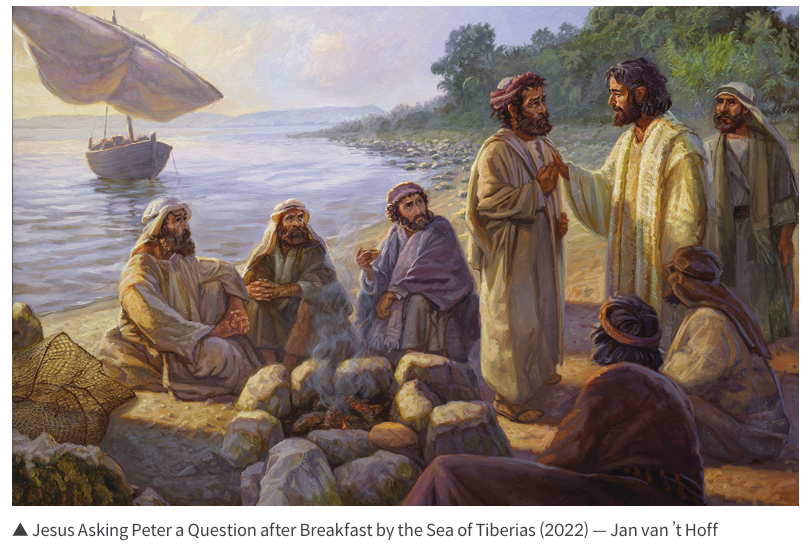
Jesus, loving His disciples so much at the Sea of Tiberias, called them, “Children.” When He asked, “Children, you do not have any fish, do you?” and they answered, “No,” He commanded them to cast the net on the right side of the boat (John 21:5–6). The disciples were men who had made their living on the sea all their lives and were very skilled, so to command them to cast the net on the right side did not make sense. yet, having toiled all night without catching a single fish, they cast their nets in a state of despair. At that moment, they caught so many fish that the net was about to tear (Luke 5:5). As the disciples rejoiced, Jesus said, “I have already prepared the charcoal fire. Come and eat,” and no one dared to ask Him who He was. From that moment, their eyes were opened and they realized, “This is the risen Jesus.” He told them to come and have breakfast and to bring some of the fish they had just caught as well (John 21:9–10). There is a reason He told them to bring the fish they had caught along with the spiritual bread and fish He had personally prepared. The Lord took the bread and the fish and gave them to the disciples, and they received it with reverence and fear. This moment was the invitation to the holy breakfast.
On the charcoal fire were two kinds of fish: the fish prepared by Jesus and the fish caught by the disciples. He did not want to give them disappointment and discouragement, but joy. He wanted them now to live without fear, believing in God in all things and hoping only in the eternal world. Therefore, He sought to restore everything. Though the disciples had betrayed Him and fled, He wanted them so no longer remember it, but desired that their relationship with Him continue in intimate fellowship as before. He also wanted to restore the broken relationship with Simon Peter. At the moment Peter had cursed and sworn, Jesus, as if saying with His eyes, “I don’t even remember that,” asked him, “Do you know why I lit this fire that warms the cold air here? You cursed Me at a fire, but at a fire I bless you and desire that your faith be restored.” In this way, unseen, a flow of heart to heart was taking place.
The charcoal fire Peter warmed himself by at the high priest’s house is called “anthrakia” in Greek. There, he cursed Jesus and swore that he did not know Him (Mark 14:71). Now, before the charcoal fire that Jesus had prepared, He desired that there would be a true confession of faith. Today, may we also be invited to that place where the risen Lord has prepared the fire, and have a holy resurrection morning, sharing breakfast together with the Lord.
This amazing breakfast carries a love that brings a runaway heart back home.
It is God’s persistent and infinite love and mercy that brings us back again, and Jesus’ hands-on teaching that makes us realize it through patience. How many times have we claimed to believe in Jesus, yet like Peter, we have cast aside our church life and lived as if we ourselves were God, doing whatever we pleased? When we sin, we feel the sting in our conscience. But repentance is not easy. Even while thinking, “I shouldn’t be doing this,” because the flesh is weak and we are overtaken by darkness, we continue to sin.
Satan leads us to sin until we die, and in the end makes it all exposed. He manipulates our hearts, saying, “If you don’t listen to me, I will proclaim your sins everywhere” (Num 32:23). He causes us to sin, strips us bare, shames us, and in the end it is said that he will burn everything and destroy us (Rev 17:16). When we read such words, does it not send a chill down our spine? Sin feels good and sweet at the time, but in the end we are judged by the wages of sin. Sin leads to ruin, and the wages of sin is death (Job 4:7; Rom 6:23).
For the disciples who had left Jesus and become like runaways, the Lord Himself prepared food, fed them, and served them, and led them to repentance again. Look at His boundless love. If Jesus is absent, can you catch fish? You cannot. A beginning without Jesus is meaningless. How long do we live on this earth? We must prepare for heaven. This does not mean preparing to die, but rather working for heaven from a young age. That is how you prepare to go to heaven. In our daily lives, there are times when we forget Jesus. But Jesus does not forget us and follows us to the very end. Christ is the resurrection and the entirety of our lives.
So how can we start without Jesus? We must proceed with Jesus and finish with Jesus. People have an end, but Jesus, who is from eternity to eternity, has no end. Jesus is forever love and grace.
Although He is God, Jesus also gave thanks to God. A group, an individual, or a family that overflows with thanksgiving will not perish. But where there is no thanksgiving, there is no contentment—only complaints. We are told not to harbor complaints or grievances, and even if we are angry, not to let it last until evening. We are told to love our enemies. How can we love our enemies? He even said, “If your enemy is hungry, feed him,” and to pray for your enemies, and that if you do not do this, He will not forgive your sins either (Matt 18:35). “If each of you does not forgive his brother from your heart, your heavenly Father will also do the same to you.” When I read this word, honestly, it makes me tremble with fear.
The breakfast by the Sea of Tiberias was a time of grace. It was a gracious moment in which the living Christ led Peter and the other disciples to look back at their hearts, yet the disciples did not realize it was a time of grace and were filled with fear and dread. They returned to their old selves and their former way of life, thinking, “We should just go back to catching fish and live like that.” How miserable and empty that moment was! The Lord was there, but they were afraid and could not even call out to Him. Jesus had no nets or tools, yet there was a charcoal fire, and bread and fish were laid out. It was like when the people of Israel slept at night and manna came down with the dew. Even as they ate the miraculous fish and bread, the disciples had no thanksgiving. Should they not have asked Jesus, “There are no nets, no boat, nothing. Where did this fish and bread come from?” But they did not ask. Haven’t our lives passed like this? We failed to believe in God’s power and authority, and we failed to believe the Scriptures. The seven disciples were people who declared independence from Jesus, saying they would live without Him. Anyone who declares independence from Jesus is a sinner. How can we live without Jesus? Sin is, in truth, declaring independence from Jesus.
After breakfast, Hesus asked Peter, “Simon, son of John, do you love Me more than these?” Peter answered, “Lord, I love You.” With this, He restored the first denial. It is a moment that brings tears. He was the one who had cursed Jesus and even sworn against Him. Receiving that confession, Jesus said, “Tend My lambs.” Again He asked, “Simon, son of John, do you love Me more than these?” and Peter answered, “Lord, I love You.” And Jesus said, “Tend My lambs.” A third time He asked, “Simon, do you truly love Me?” and again said, “Shepherd My sheep.” When He asked a third time, Peter became grieved and said, “Lord, You know all things,” and he wept. He could not even lift his face before Jesus. Up to the second time his heart was still unsettled, but by the third, he came to think, “Now even if the Lord leaves, I can live with His heart and carry out my calling,” and Jesus was at peace. So He said, “Tend My sheep,” and, with the heart of entrusting everything to him, He gave him his mission again.
The conclusion of receiving the in- vitation to the holy breakfast is, “Tend My sheep!”
Because he did not love, Peter betrayed Him, and now the Lord is asking for his love again. Peter is one who received the Lord’s love and came to realize and receive the grace of that burning love of the cross. The Lord showed him that He was crucified in place of Peter’s sin. He showed the marks of the crown of thorns on His head, His hands torn and pierced with nails, and His side and feet, revealing the great love He carried out for all mankind.
Hymn “I Gave My Life for Thee”
(1) I gave My life for thee,
My precious blood I shed,
That thou mightst ransomed be,
And quickened from the dead; I gave, I gave My life for thee,
What hast thou done for Me?
I gave, I gave My life for thee,
What hast thou done for Me?
(2) My Father’s house of light,
My glory-circled throne
I left for earthly night,
For wanderings sad and lone;
I left, I left it all for thee,
Hast thou left aught for Me?
I left, I left it all for thee,
Hast thou left aught for Me?
It is the same today. He asks, “Believers, do you love Me more than your parents, your relatives, your children, your possessions, your business, more than anything else?” The reason He asked Peter three times in a row was to restore what Peter had denied three times, cursing and swearing while warming himself by the fire in the courtyard of Caiaphas. Today, He comes to us through His word and does the same thing. Are you not the Lord’s disciples? How many years has it been since we believed in Jesus? In the courtyard of Caiaphas, when a young servant girl pointed at Peter and exposed him, saying, “This man was with that Jesus,” Peter denied it, saying, “What are you talking about? I do not know Jesus.”
At the third questioning, he again repeated that he did not know Jesus, striking his chest, and cursed and swore (Luke 22:55; Matt 26:69–75).
At the third denial, while Jesus was on trial, He turned and looked at Peter, and their eyes met (Luke 22:62). Does a sinner have the right to love the Lord? No. A prodigal child who has rebelled against his parents cannot love them. A wife who has betrayed her husband does not love him. But parents can love an unfilial child (Luke 15). For Peter, who had cursed the Lord, sworn, and denied Him three times, to say that he loved Jesus was a shameless confession. Peter, overwhelmed with fear, could only fill with tears and repeat, “Lord, You know all things… I love You.” Jesus read Peter’s heart, which truly repented and was remorseful, and said, “Simon, son of John, tend My sheep. I am now going to the Father; you carry out the remaining mission.” When the Lord asks, “Do you love Me?” it truly means infinite forgiveness, mercy, and compassion, and carries the message: receive your calling again, live a life that pleases and desires God to the end, and come before Me.
The only true forgiveness in this world is the infinite love of the cross.
At that time there were 24,000 pastors, along with many Pharisees, scribes, elders, officials, and priests, yet not one of them received Jesus. Before the cross, they spat on Him, struck Him, and cursed Him (Ps 22). Toward them, Jesus prayed, “Father, forgive them; for they do not know what they are doing.” Has not our life until today also been a life of denying Jesus? This morning, the resurrected Lord has invited us to breakfast, and as He eats with us, He has reaffirmed His love once again. The command, “Tend My sheep,” means that we must go out and evangelize. There are many who were absolutely predestined in Christ before the foundation of the world to be saved. If you truly believe in the Lord’s resurrection and life, you must not only believe alone, but first share the word with your parents, relatives, siblings, your children, and your sons- and daughters-in-law. The gospel must be proclaimed not only in Jerusalem, but also to the Gentile nations and to the ends of the earth. We who have received the blessing of the resurrection should, from today, go out and become spiritual messengers of heaven, delivering the news of the resurrection—that Jesus has risen again—bringing comfort and hope to those who are perishing. Now we have hope. For those who believe, there can never be despair. From now on, may our lives begin with the Lord, proceed with the Lord, and finish with the Lord, and may the result be a life that reports back with thanksgiving in prayer to God.
Hymn “Rock of Ages, Cleft for Me”
(1) Rock of Ages, cleft for me,
Let me hide myself in Thee;
Let the water and the blood,
From Thy wounded side which flowed,
Be of sin the double cure;
Save from wrath and make me pure.
(2) Not the labors of my hands
Can fulfill thy law’s demands;
Could my zeal no respite know,
Could my tears forever flow,
All for sin could not atone;
Thou must save, and Thou alone.
(3) Nothing in my hand I bring,
Simply to the cross I cling;
Naked, come to Thee for dress;
Helpless, look to Thee for grace;
Foul, I to the fountain fly;
Wash me, Savior, or I die.
(4) While I draw this fleeting breath,
When mine eyes shall close in death,
When I soar to worlds unknown,
See Thee on thy judgment throne,
Rock of Ages, cleft for me,
Let me hide myself in Thee. Amen
The Lord’s death is our death, so the Lord’s resurrection is our resur- rection and our eternal life.
How great is this hope! If we strive to liveaccording to God’s will, we can live without ever committing sin. Didn’t the Lord say, “Do you love Me? If you love Me, offer your body for Me”? The first time, “Do you love Me? I died for you, so should you not live for My will?” The second time, “I have forgiven you.” And the third time, “Receive the inheritance of My kingdom and take good care of My sheep.”
Today, on this resurrection morning, we have been invited to the shores of Galilee, and we have all eaten breakfast together.
Paul understood the meaning of this spiritual word and said, “Now I rejoice in my sufferings for your sake, and in my flesh I do my share on behalf of His body, which is the church, in filling up what is lacking in Christ’s afflictions” (Col 1:24). I pray that you also would take on the remaining sufferings of Jesus and live according to the Lord’s will, and whether you eat or drink, live for the glory of the Lord and enter that kingdom abundantly as precious believers. On this glorious resurrection morning, I bless you in the name of the Lord that you all may understand these truths, give thanks, and give glory to Him.
Let us pray.
The apostle Paul resolved, “I rejoice in my sufferings for your sake, and I will fill up what is lacking in Christ’s afflictions for the sake of the church.” In Colossians 2:3, it says that only Jesus Christ is the mystery of God, and that in Him are hidden all the treasures of wisdom and knowledge. Beloved Lord, on this Easter day, You personally prepared the charcoal fire, the fish, and the bread on the shore of the Sea of Tiberias in Galilee, and invited us, saying, “Come and have breakfast together.” We said “Amen” and ran to You, and ate breakfast with You. From now on, as we live the rest of our lives solely for You, may our lives be one of walking with You, starting with You, proceeding with You, and finishing with You, and let there be a living work in which our faith does not grow weak to the end. Grant us faith that looks only to You and firmly believes only in You. Just as You were pleased when You saw the great faith of the Canaanite woman, please look upon our faith and let there be a work in which You rejoice over us on this resurrection morning. Grant great and blessed faith to every family. As we pray and ask all these things, we offer this prayer of thanksgiving in the holy name of Jesus. Amen.
April, 16, 2006, Easter Sunday Sermon by Rev. Abraham Park
- 26년 3월호